I offer talks on my career as designer and writer. These are
illustrated with a host
of patchwork quilts that will, I hope, inform and
inspire you. Talks last about one hour,
they are informal with opportunities
for questions and answers.
| 1. A Quilters Journey -
a 'hands on' tour of quilts made over the last 20 years with related
stories and tips. Mostly Scrap Quilts representing Katharines progress as
a quilter, from the early use of dressmaking offcuts to designer fabrics
custom made for quilters. |
|
2. Small and Miniature
Quilts. Demonstration and talk. A collection of small and miniature quilts
in a variety of styles and techniques, ranging from traditional blocks
such as 'Roman Stripe', 'Churn Dash' and 'Broken Dishes' to 'Modern Art
Minis'
|
|
Katharine's Workshops.
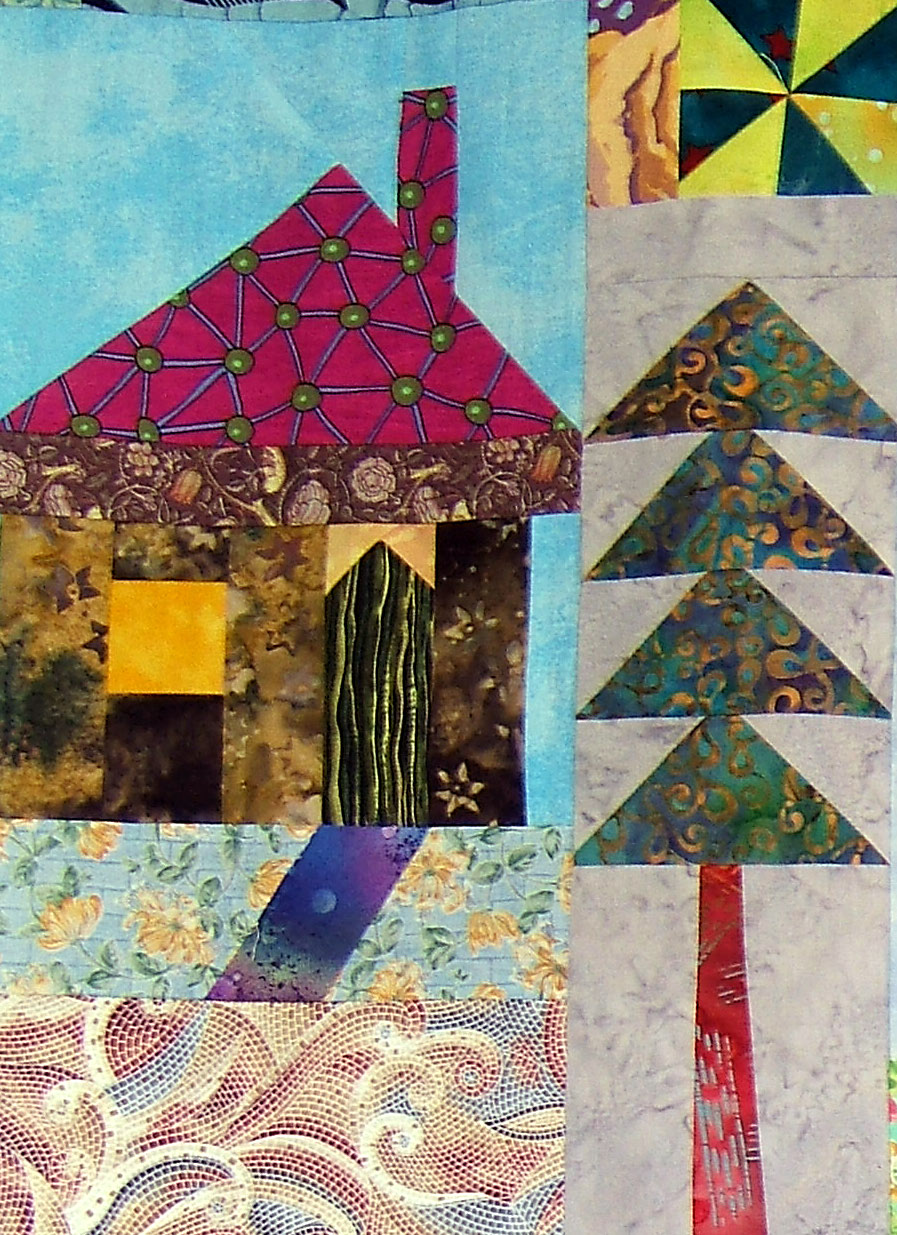
House Blocks With AttitudeLiberated piecing
techniques are applied to house blocks to give your quilts that contemporary
look. This is an improvisational way of working without templates and no two
house blocks turn out the same. Quick pieced flying geese units are adapted to
make pine trees, then a border of irregular sawtooth sashing and simple blocks
completes your quilt or wallhanging which can be made any size from small
wallhanging to king size. You will learn a variety of piecing techniques
including how to fit all these separate pieces together into an effective and
individual quilt. All template free. A relaxed day when you don't have to worry
too much about precision piecing. Ideal for scrapbag quilts to use up those
bits. Students will need to be familiar with the rotary cutting set and straight
stitch on the sewing machine | |
Colour Blocks and Wacky StarsNo need for
templates or any measuring when you make the colour blocks in this technique.
You select a set of fabrics to work with, which can be arrestingly bright, or a
co -ordinating colour scheme,depending on your mood, then cut and sew. It's as
easy as that! Minimal measuring or marking makes this a relaxing day when you
can let go, enjoy yourself and create surprisingly fast results. The second
block in the workshop combines well with 'colour blocks' and is totally
liberated piecing - a technique found in the book of the same name by Gwen
Marston. No two stars turn out the same and you can make them in any size, which
can be made to fit alongside the colour blocks using Katharine's fiendish
fudging methods.The blocks can be used in a number of ways and are suitable for
quilts, cushions or bags.Students must be familiar with the rotary cutting set
and sewing machine. A recent addition to this workshop is the 'tilted pinwheel'
block which also combines well with the previous two. | |
Cropped PinwheelsThe quilt which forms the basis of this
workshop was in the Quilters Guild exhibition at Dean Clough in Halifax (1996)
and was subsequently accepted for the A.Q.S. show in Paducah. U.S.A. in 1997.
The technique was recently featured in 'Patchwork and Quilting' magazine with
additional samples. The idea of cropping a simple block gives any piece of work
movement and can be used in a variety of ways to produce a unique and original
piece of work. Suitable for quilts and smaller items such as cushions, bags etc.
Students will need to be familiar with the rotary cutting set and basic machine
piecing. | |
Stars and Scraps:Scrap QuiltStars and Scraps: Scrap Quilt
Based on the quilts 'Stars and Scraps' which won a first prize in its category
at the Festival of Quilts at the N.E.C. in Birmingham 2003 and featured in
'Fabrications' magazine, this workshop will show you how to make effective scrap
quilts from a number of simple star blocks combined with scrap fabrics. Quick
piecing and rotary cutting techniques cut out the need to use templates and
speed up the production process. Students must be familiar with the rotary
cutting set and the sewing machine as this method of working requires precision
in both the cutting and the sewing of an accurate ¼-inch seam.
| |
Scrap Quilts for the fabric collector.Forget 'Formula'
quilts which use blocks, strips or repeating patterns. This workshop will teach
you how to manipulate simple shapes using quick piecing techniques to create a
unique piece of work. Using as many fabrics as you have in your collection you
will combine triangles and squares in a variety of sizes to make a rich pattern
and suface texture for your quilts. The workshop will be illustrated with
examples of the technique to inspire you but at the end of the day each piece of
work created will be different. Most effective for quilts but could be used in
smaller items such as bags or cushions. | |
Mix and Mash MinisWhat are 'Mix and Mash Minis?!' These
are little quilts which incorporate a number of different piecing techniques.
Because they are quick to make, and economical on fabric you can afford to be
more adventurous with colours and the way you put the different elements
together. They can be treated as a 'sketch' for a larger quilt or as little
works of art in their own right. Inspirational samples to study on the day which
you will be welcome to photograph. What will I learn in a day? Quick piecing
techniques combined with rotary cutting, no template methods of making the basic
units needed on a small scale. Joining strips with curved seams but without
templates, tilted blocks, wavy borders, prairie points and more. Confidence in
handling colour and combining geometric shapes. In addition, its fun,
experimental and will give you ideas to incorporate into larger pieces of work.
Students should be familiar with the rotary cutting set and sewing machine.
| |
Creative Snail TrailSnail Trail is an intriguing block
which relies for its effect on the correct placement of dark and light fabrics.
Although the design gives the illusion of curves all the seams are straight
making it fairly simple to contruct in any size, either by regular or foundation
piecing methods. Both techniques will be explained. Once the blocks are made
there are a number of ways to put them together giving a variety of options for
the finished quilt. Snail trail blocks can also be used for smaller items such
as cushions or bags if you don't want to embark on another major project.
| |
Patchwork Postcards and Pinboard QuiltsLearn to manage
composition with shapes and colours on a miniature scale of 6½" x 4½" Piecing
techniques include curved seams, strips and prairie points. Each 'postcard' is
interlined with 'stitch 'n' tear', backed with handmade paper, then machine
quilted ready to frame or mount onto a small canvas. A miniature 'Art Quilt'
They are also ideal for individual greetings cards. In a one day workshop you
will have time to make several finished postcards to explore the principles of
abstract shapes, line, form and colour. Another option is to make a 'Pinboard
Quilt' a small quilt using similar techniques which is finished with wadding and
quilted by machine. Lots of samples to inspire you on the day.
| |
The Versatile GooseLearn a quick method of making the
Flying Geese units, which are made from two sizes of triangle - one larger one
(the 'goose') and two smaller ones (the background or 'sky') and then make a
selection of blocks using this unit. 'Dutchman's Puzzle', 'Eight Pointed Star'
and a 'Sophisticated Pinwheel' as well as Flying Geese itself are all possible
in a short time. Very versatile for blocks, borders, sampler quilts and smaller
items such as cushions bags and wallhangings. Lots of samples to inspire you.
All skill levels. Sewing machine required. | |
Beside the SeasideIn this workshop, students will learn
how to piece miniature patchwork blocks on a seaside theme: Beach-huts, Sailing
Boats, Fish and a Lighthouse using the foundation method. This involves
stitching the patches to a lightweight fabic foundation onto which a design has
been stamped or drawn. Blocks can be used to make an individual greeting card or
as the beginning of a small wallhanging, cushion or bag. There will be a
collection of miniature quilts to study as examples. | |
Return to Home Page |
|
|
|

|
|